
1. Sensor inputs
RGB/IR, thermal, and optional radar or UWB sensing support perception in degraded environments.
The technology stack combines wearable sensing, local compute, contextual memory, and SOP-aligned reasoning to produce real-time advisory outputs directly on-device.
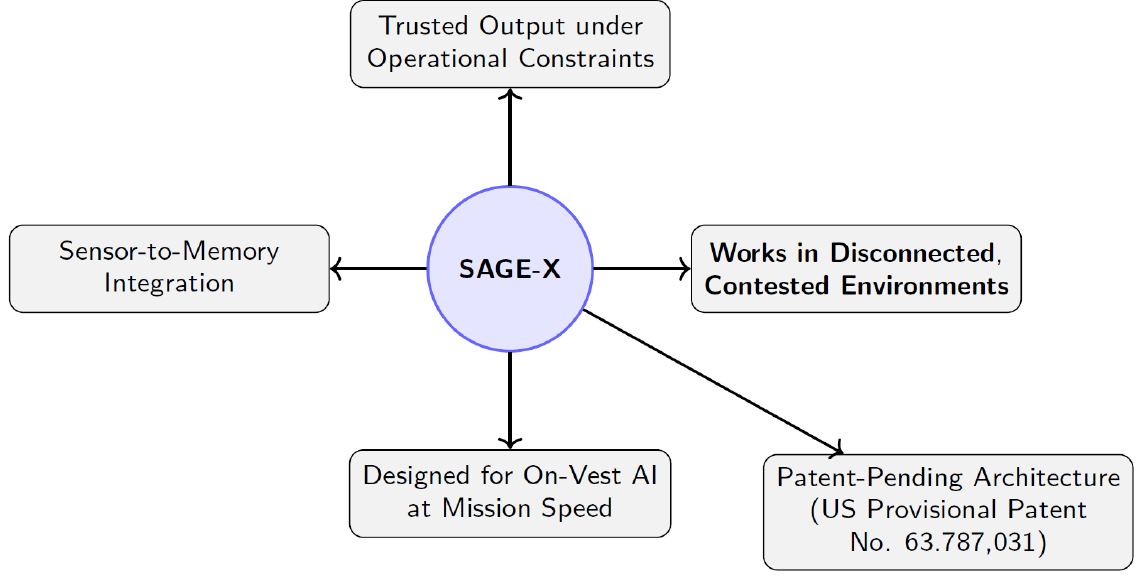
SAGE-X is described as a wearable AI system that integrates RGB/IR, thermal, and optional radar or UWB sensing with an embedded compute module configured to execute perception and reasoning locally. The architecture is intentionally offline-first, with optional remote services limited to updates, telemetry synchronization, and diagnostics when connectivity is available.
The system may deliver outputs through visual, auditory, or haptic interfaces, depending on the operational context and wearable configuration.
SAGE-X moves from raw sensing to fused observations, contextual interpretation, and concise advisory guidance for the operator.
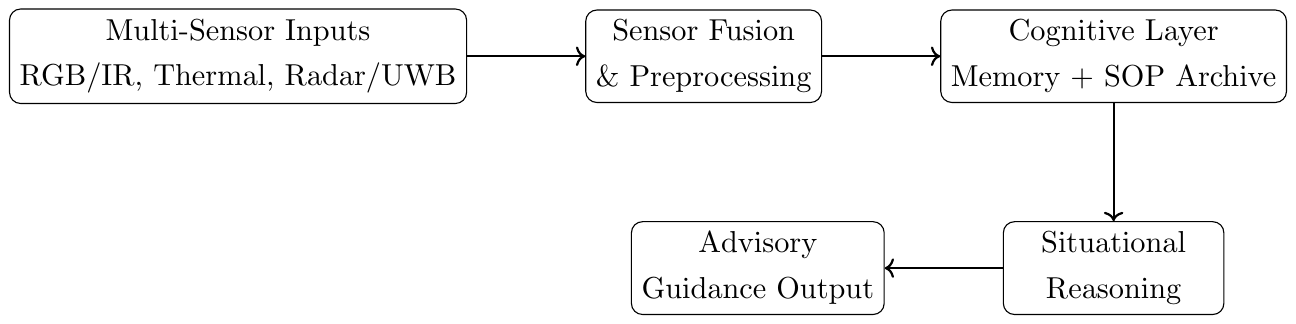
RGB/IR, thermal, and optional radar or UWB sensing support perception in degraded environments.
Signals are harmonized before reasoning to produce a more coherent operational picture.
Short-term memory, episodic context, and SOP archives inform how the system interprets the current scene.
Concise guidance is delivered to the operator through mission-appropriate interface modes.
The architecture selectively combines SOP archives, an episodic buffer, and short-term memory with a sensor-informed gating controller and on-device AI execution.
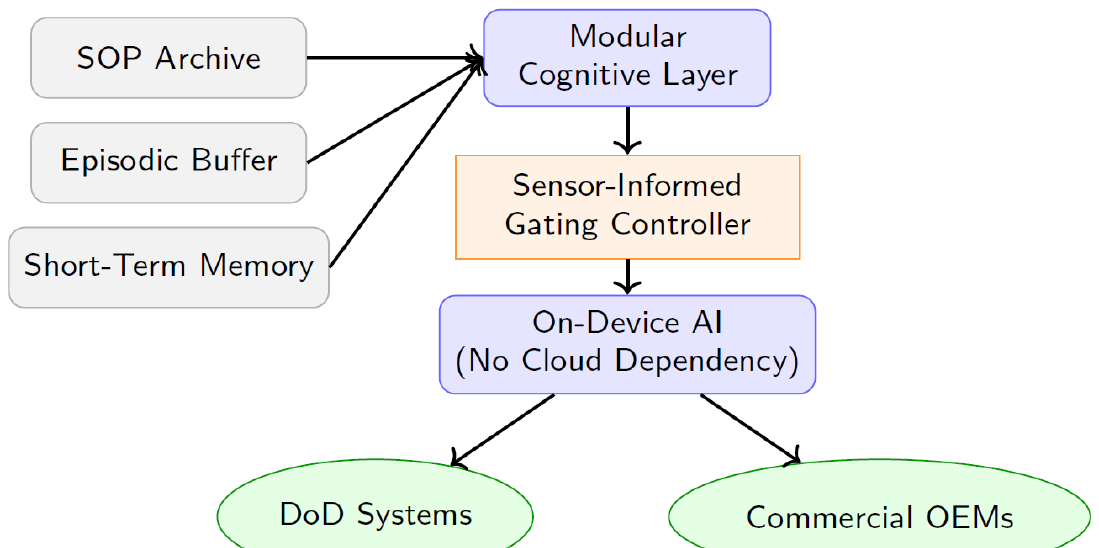
The system’s differentiator is not simply the sensor stack. It is the ability to connect sensed observations to procedure, memory, and confidence logic on the device itself. That enables guidance that is more usable under time pressure and in constrained operational conditions.
A full reference platform that demonstrates sensing, reasoning, and advisory output in an on-body system.
Software and cognitive-layer integration into external mission systems, head-worn platforms, or partner sensor stacks.
A commercialization path aligned to the architecture’s explicit fit for commercial OEM integration and partner-led deployment.
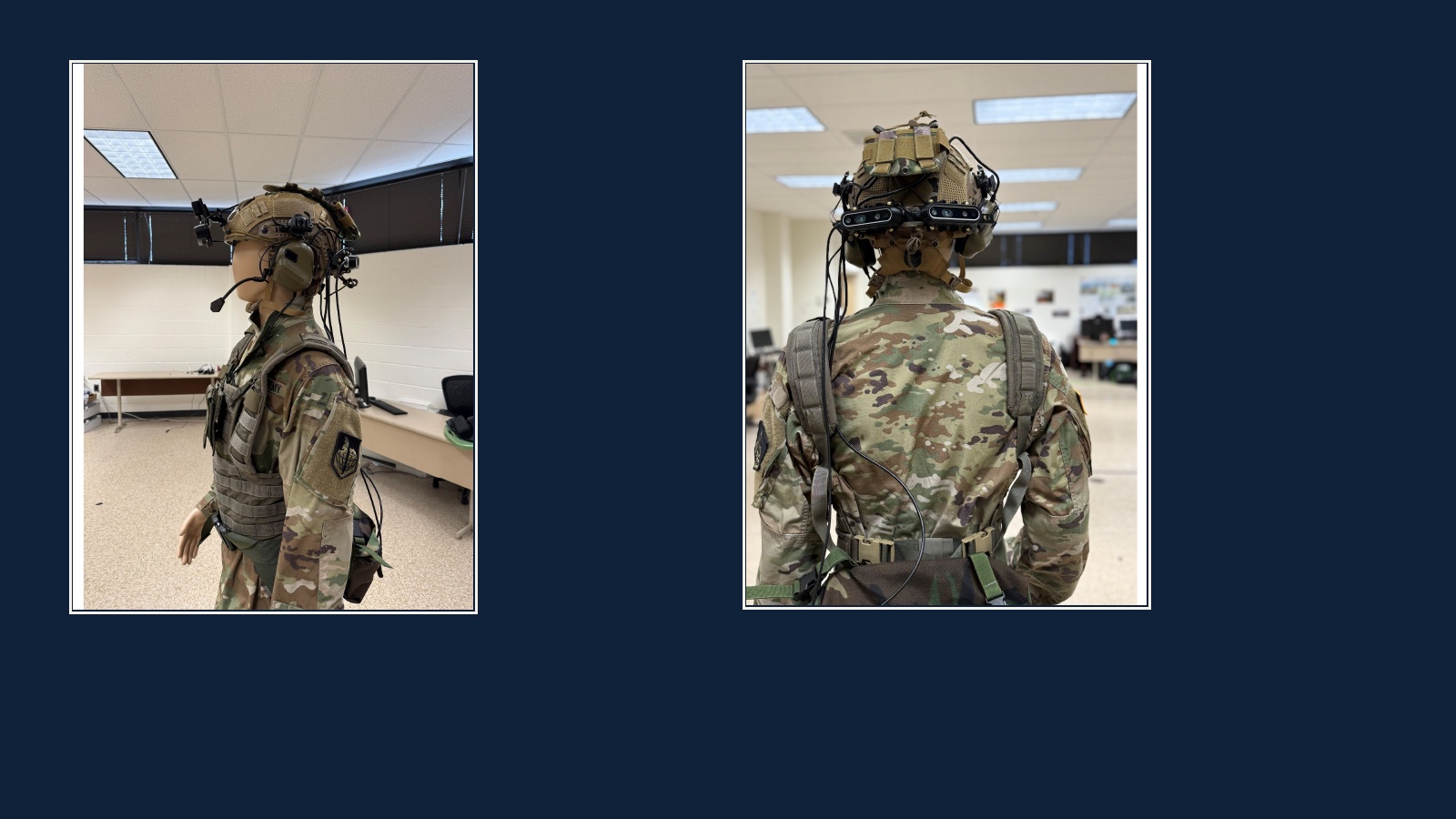
Extensibility is a core design principle: additional physiological or environmental sensors can be integrated without redesigning the cognitive layer, enabling domain-specific product configurations over time.
Use this page to support partner, customer, and investor diligence around the architecture.
SAGE-X is an extensible, on-device advisory AI architecture that fuses multi-sensor inputs with memory and operational procedures to support real-time decision making.
No. The system is designed to operate offline, with optional remote services available for updates, telemetry synchronization, diagnostics, or model refresh when connectivity exists.
The current concept references RGB/IR imaging, thermal sensing, and optional radar or UWB modules, with extensibility for additional physiological or environmental sensors.
The core application areas described for SAGE-X are military operations, emergency response, industrial safety, and disaster response scenarios.
KestrelAI is positioned for pilot programs, system-integration discussions, OEM partnerships, and investor conversations related to the commercialization of SAGE-X.
Use the contact page to request a technical briefing, pilot discussion, or partnership conversation.